Showing posts with label LLK. Show all posts

Saturday, July 15, 2017

Beyond Magenta: Transgender Teens Speak Out

Beyond Magenta: Transgender Teens Speak Out
By Susan Kuklin
Candlewick Press, 2014. 182 pages. Young Adult Nonfiction

Beyond Magenta is a window into the lives of six teens who have blurred traditional gender lines. Kuklin conducted personal interviews to write the book, but she quickly fades to the background as full page photos and first-person narratives help the teens tell their own stories. Four of the six teens are transgender, identifying themselves with a different name and sex than what appears on their birth certificates. From childhood to college years, these teens describe their lives and the pivotal events that led them to where they are now. From the first time they questioned their gender, to coming out to their parents, to making the decision to transition, each of the four has something new and different to share. The remaining two teens are queer and intersex, respectively, and their tales broaden the book even further by calling into question the simple delineation of trans-gendered and cis-gendered.

I saw this book on a library display and couldn’t look away from the beautifully androgynous teen on the cover. It intrigued me. Wasn’t the point of swapping genders to be convincing in your chosen role? Once I started reading I couldn’t put it down. I had to know what would happen next. Would Jessy’s family accept him as a “him”? Would Mariah achieve the body she always wanted? The more I read, the more my original question about the cover lost its meaning. Beyond Magenta demonstrates that gender isn’t a black-and-white dichotomy, but a spectrum, and that any place on the spectrum can be okay. This book can be hugely helpful for teens who are exploring their own gender identity, but I think the intended audience is broader than that. All of us could be more understanding of the transgender community, so I would recommend this book to anyone who wants to learn more about LGBTQ issues.


LLK

Friday, July 7, 2017

For the Relief of Unbearable Urges

For the Relief of Unbearable Urges
By Nathan Englander
Vintage International, 2000. 205 pages. Fiction

This short story collection showcases devout Jews in a variety of situations, from familiar to strange. Yiddish authors in Russia discuss literary theory before being executed. The Hasidim of a German ghetto escape the concentration camps by posing as circus acrobats. A wigmaker travels outside her insular Jewish community and ends up blackmailing a New Yorker for his hair. In the title story, a Hasidic man in Jerusalem is surprised when his rabbi gives him special dispensation to visit a prostitute.

The first thing to know about this collection is that the stories are meant to be Literary with a capital “L.” The writing is phenomenal, but occasionally self-engrossed. I would still say that the read is well worth it, though. The characters are real and provide a fascinating window into Jewish culture. The more you read, the more comfortable you become with the Jewish world—the world of rabbis, Hasidim, and Israeli-Palestinian conflict. As the surroundings fade away into familiarity, you come to recognize who the people in the stories would be without their obvious identifying markers: humans just like the ones we interact with every day. I found this collection powerful and enlightening, and I would recommend it to fans of Jonathan Saffron Foer and to fans of literary fiction in general.


LLK

Thursday, June 1, 2017

I'd Rather Eat Chocolate: Learning to Love My Low Libido

I’d Rather Eat Chocolate: Learning to Love My Low Libido
By Joan Sewell
Broadway Books, 2007. 213 pages. Nonfiction

Welcome to the life of Joan, a low-libido woman in a relationship with Kip, a high-libido man. Joan thinks everything is going fine with her 3 times a month “false spontaneity” plan until she asks Kip how often he would like to have sex. The answer shocks her and sends her on a quest to step up her libido. She recounts with brutal and often hilarious honesty her attempts to try everything that the sexperts recommend, from spiritual mindfulness to wearing thongs. As each prescription fails to affect a cure, however, Joan starts wondering if anything is actually wrong with her and whether the “experts” she sees on TV know as much about women as they think they do.

This book was a page-turning, laugh-out-loud blast. I read the entire thing in pretty much one sitting because I couldn’t put it down. I was curious to see how each new “solution” would play out, and Joan’s conversational tone wrapped me up in her story. While she tends to show herself in a somewhat deprecating light and writes Kip as a martyr, both people come across as so real and relatable that you can’t help but find out what happens to them. Joan keeps a lively sense of humor throughout, so even the toughest topics keep from being too dark. I think this book is a marvelous manifesto on the libido gap between men and women, and I would highly recommend it to anyone interested in a modern rethink of the outdated Men Are from Mars, Women Are from Venus.


LLK

The Long Earth

The Long Earth
By Terry Pratchett and Stephen Baxter
Harper, 2012. 336 pages. Sci-Fi

In this non-Discworld novel, Terry Pratchett and co-author Stephen Baxter explore an interesting concept: what if humans had the ability to reach all the Earths that could have been? After the invention of a simple device powered by a potato, the people of the world discover that they have the ability to Step—to travel to neighboring Earths on the possibility tree. What if the Ice Age had never ended? What if humans had never evolved? What if, what if. Each one of these options suddenly becomes a place that humanity can visit. The further you get from home, or “Datum Earth” as it’s now called, the stranger things become. Two adventurers—a sentient computer program named Lobsang and a Davy Crockett-style celebrity Stepper named Joshua Valienté—embark on a quest to Step as far as they can and discover the end of the Long Earth.

Fans of Terry Pratchett will definitely find his signature style within this book. Lobsang, a computer program who claims to be a Tibetan motorcycle repairman reborn, is pure Discworld. However, this work is far more contemplative than most of Pratchett’s humor writing. There are very few laugh-out-loud moments, and the book occasionally reads more like a pop science article than a novel. The emphasis is definitely on the concept more than the characters or plot. This leads to a slower pace, and I often found that I enjoyed thinking about the book more than I did actually reading it. Despite cosmic focus, however, I found Lobsang and Joshua both charming and their interactions amusing, and I was as eager as they were to discover the end of the Long Earth. I would recommend this book to anyone looking for an interesting soft sci-fi that might change the way you look at the world, or (of course) to fans of Terry Pratchett.


LLK

Wednesday, May 17, 2017

The Dark Talent

The Dark Talent
By Brandon Sanderson
Starscape, 2016. 300 pages. Young Adult

It’s finally here! It took almost seven years, but Alcatraz #5 is out and the series is finished. And yes, there is an altar of outdated encyclopedias. It took him long enough.

Book #4 (Alcatraz versus the Shattered Lens) ended on a definite cliffhanger. Alcatraz had somehow managed to break the Smedry Talents, Bastille was in a coma, and the Free Kingdoms were in eminent danger. #5 picks up right in the middle of that mess. After fighting on Librarian terms for so long, Alcatraz is angry and ready to take the fight to the Librarian capital, aka the Highbray in Washington D.C. His Grandfather is, of course, up for anything that audacious, and Kaz and a new Smedry cousin named Dif join in. Oh, and Alcatraz’s mother. THAT isn’t awkward at all.


A few things have changed in the past six years. First of all, it seems that “Alcatraz versus” is no longer a part of the title; it’s just the series name. Also, the Alcatraz series now has an illustrator! Though sparse, the drawings by Hayley Lazo were excellent and I found them a welcome addition to the Alcatraz universe. As far as the actual content goes, The Dark Talent fulfills all the promises of the previous Alcatraz books. It continues the same humor, the same exciting storylines, and the same (mostly) loveable characters. But it also delivers something the rest of the series has been none too subtly hinting at the whole time: the reason that Alcatraz isn’t the hero everyone thinks he is. This series-ender is dark and may leave many readers dissatisfied, but you can’t deny that Alcatraz warned us. Many plot points are left hanging, but the final pages also include the hint of a sequel series, so it seems the story WILL continue eventually. All in all, though The Dark Talent doesn’t knock it out of the park the way Shattered Lens did, the book is definitely worth reading and the (kind-of) surprise ending will make you excited for whatever Sanderson comes out with next.

LLK

Thursday, May 4, 2017

The Bell Jar

By Slyvia Plath
Perennial Classics, 1999. 264 pages. Fiction

The time is the 1940s, and Esther Greenwood is at the peak of her college life. She has friends of all sorts (from kind to sassy), she’s on scholarship, she has a beau in medical school, and she’s won a month in New York City working on a fashion magazine. Though showered with free makeup, heaps of caviar, and fancy parties, New York is where things start to fall apart. Always the girl with a plan before, she starts to lose sight of her goals and motivation. She finds that she won’t do what she’s supposed to, but can’t quite do what she isn’t supposed to either. Suddenly she stops getting out of bed. She can’t sleep, can’t read, and is forced to move home with her mother. After an attempted suicide, her mother places Esther in an asylum. She has experiences with behavioral and shock therapy, both good and bad, and slowly moves up through the ranks of mental illness, gaining more and more of herself back as she goes.

Originally published in 1963, The Bell Jar is a captivating look at mental illness before the DSM. Esther’s plight sucks you in as a reader, and there is a sort of horrible fascination to watching “medieval” psychiatry at work. Even more than that, however, is the painfully personal and accurate picture of clinical depression that Plath paints. The book is largely autobiographical (though the names have all been changed), and it shows in the detailed nuances of Plath’s writing. No one could describe depression so perfectly without having been there. Though this book is often read in high school English classes, its powerful messages apply to a much broader audience. Since one in three college-age females suffers from depression, this is a book of vital importance to the secondary education crowd.  Even beyond that, I would wager that everyone in the United States knows someone struggling with depression, whether they know it or not. This book is an important piece of validation for those suffering and of understanding for those who want to help, and as such I would recommend it to anyone who is willing to struggle with some heavy themes.

Oh, and the writing is gorgeous. Can’t forget that.


LLK

Thursday, April 27, 2017

Alcatraz versus the Shattered Lens

Alcatraz versus the Shattered Lens
By Brandon Sanderson
Scholastic Press, 2010. 292 pages. Young Adult

The kingdom of Mokia is under siege by Librarian forces, and it might take a Smedry to save it.  Alcatraz has a hare-brained scheme to rescue the capital of Tuki-Tuki, but things might not go according to plan. He’ll need the Knights of Crystallia, some Nalhallan flying machines, and his grandfather to join the fight as soon as possible. Knowing that Levenworth Smedry is involved, however, they’ll probably be late.

This book is the crowning gem of the Alcatraz series. I don’t know yet what book 5 has to offer, since it just recently came out, but Alcatraz versus the Shattered Lens kicks the trash of all the previous volumes. The plot is more intense, the characters are more developed, and everything is WAY funnier. Sanderson experiments with form, making fun of writing conventions and twisting them on their heads. He references classical literature with a sardonic edge, messes with dialogue, and gives his chapters totally ludicrous titles. In my reread of the series there have been very few things that made me laugh out loud (a joke is never as good the second time you hear it), but during this one I was giggling my head off late into the night. Highly recommend. Even if you were starting to get tired of the series, push through. It’s worth it.

LLK

Thursday, March 30, 2017

Alcatraz versus the Knights of Crystallia

Alcatraz versus the Knights of Crystallia
By Brandon Sanderson
Scholastic Press, 2009. 299 pages. Young Adult

After an extended detour to the Library of Alexandria, Alcatraz finally makes it to the Free Kingdoms. Turns out the librarians haven’t been idle in the meantime. They’ve sent ambassadors to Nalhalla with a treaty that could end the war… as long as the Free Kingdomers are willing to give up Mokia. Though some people think it might be worth it, Alcatraz knows there’s something suspicious going on. After all, you should never trust a librarian.

Sanderson really hits his stride with this third installment in the series. Not only is the plot an interesting change of pace with a bit of political intrigue, but Alcatraz’s comedic asides really come into their own. Each interjection actually enhances rather than detracting from the narrative, and there’s plenty of new material rather than tired tropes. My particular favorite is the way he undercuts the formulaic moral lessons learned throughout the story. Alcatraz is surprised to find that he is a celebrity in Nalhalla, for example, and lets the fame go to his head. Instead of turning this into an unbearable teaching moment, however, Alcatraz’s snarky interjections keep things real. Overall an improvement on #2 and a strong installment in a funny series.

LLK

Tuesday, March 21, 2017

Alcatraz versus the Scrivener’s Bones

Alcatraz versus the Scrivener’s Bones
By Brandon Sanderson
Scholastic Press, 2008. 322 pages. Young Adult

Alcatraz is back for another sinister library adventure. This time he has to follow a clue about his long-lost father, even though it might lead him to the dreaded Library of Alexandria. The ghoul-like curators are after his soul, and a half-mechanical monstrosity known as a Scrivener’s Bone is after his life. Alcatraz is going to have to outsmart them both, but fortunately he has some allies. Two new Smedries—one with a talent for getting lost and the other with a talent for waking up incredibly ugly in the morning—plus two Crystin make for a formidable team. The team fight their way through the booby-trapped library and even learn a little more about the Smedry Talents on the way.

This volume is very much in keeping with the first book in the series, Alcatraz versus the Evil Librarians. It’s just as silly and ridiculous, and has just as many bizarre asides from Alcatraz. In the first book, Alcatraz attempts to prove that he is not a good person; in this second volume he tries to demonstrate that he is a liar. It actually gets a little irritating that he stops the action at the beginning of each chapter to interject some unrelated nonsense, but if you read the first book then you’re already used to that. The comedy isn’t quite as stellar since the far-fetched librarian conspiracy and the ridiculous Smedry Talents have already been established, but Sanderson definitely keeps things going in a good direction. Overall I think that this is a solid installment and the series is something I’d recommend to anyone looking for something light and humorous.


LLK

Tuesday, February 21, 2017

Emperor of Thorns

Emperor of Thorns
By Mark Lawrence
Ace Books, 2013. 434 pages. Fantasy

Jorg is back for a third and final volume, and the question is… will he finally ascend the Empire Throne? Defeating the Prince of Arrow has earned him seven kingdoms, but when it comes time for Congression, that’s only seven votes out of a hundred. An Emperor must win a majority of votes, and we all know that diplomacy is not Jorg’s strong suit. Sure, he may have mastered the ancient technologies of the Builders, but that’s not going to convince a room of noblemen who hate his guts to play nice. Not to mention the fact that everyone is distracted from the business of emperor-making by the fact that the Dead King and his army of necromancers are practically breaking down the door. Is this where Jorg’s quest for ultimate power ends, or will he continue to cheat, lie, and murder his way to the top?


This book was just as great as the first two, and provided me with the perfectly satisfactory conclusion I was looking for. If anyone read my review for King of Thorns, you’ll remember that my one complaint was that Lawrence jumped between four different timelines and it was hard to keep them all straight. This book was a little better—it had three timelines instead of four, and two of the timelines converged toward the end. It was still a little irritating, but I didn’t struggle near as much to remember what was going on. The focus of this book is definitely more on Jorg’s character than in the previous volumes, and I found it interesting to watch as he developed a little self-awareness before his final bid for victory. That being said, there’s definitely more than enough swordplay, torture, and assassination to keep things interesting. All around an excellent trilogy that I would hardily recommend to anyone charmed by a classic anti-hero.

LLK

Wednesday, February 15, 2017

11/22/63

11/22/63
By Stephen King
Scribner, 2011. 846 pages. Sci-Fi

Meet Jake Epping, ordinary high school English teacher. Meet Al Templeton, owner of the local diner and creator the infamous Fat Burger. Their plan? To go back in time and stop the JFK assassination. When the two discover a mysterious time-travel portal at the back of Al’s diner that opens onto 1958, it seems like a chance to become the heroes who saved history. The only problem is that the assassination doesn’t take place until 1963, and so whoever makes the jump will have to wait five years to stop the crime. Jake reluctantly agrees to be the one to go back, but soon finds that life follows you wherever—or whenever—you go.

This was the first Stephen King book I’ve ever read and I definitely thoroughly enjoyed it. It alternates between dramatic action scenes and much slower descriptions of the mundane life Jake builds for himself in “the land of ago.” Both were compelling, though in very different ways. Though the slow parts drag a little bit in places (as you might expect from an 800-page novel), they do a great job developing the characters so that when you get to the action scenes you’re really invested. I loved Jake’s romantic interest and all of his friends and students, and so when protecting JFK started to threaten those relationships I was genuinely distraught. I listened to the audiobook on this one and I thought the narrator was excellent. He really brought Jake Epping to life for me and made the whole book fly by.

LLK

Saturday, January 21, 2017

King of Thorns

King of Thorns
By Mark Lawrence
Ace Books, 2012. 449 pages. Fantasy

Revenge is sweet. Jorg has not only killed his uncle for the crimes he committed, but has taken control of his lands, naming himself King of the Renar Highlands. King is a good place to start, but if Jorg still wants to unite the Broken Empire beneath him he has a lot of work to do. Unfortunately, there’s another contender for the imperial throne: the charming, good-hearted Orrin of Arrow. Nobles flock to support him, soldiers rally to his cause, and every soothsayer and their grandmother predicts his glorious reign. The more people who tell him to roll over, though, the more stubborn Jorg gets, and when Arrow brings an army of 20,000 to his gates, surrender is the last thing on his mind.

This is #2 in The Broken Empire Trilogy, and I enjoyed it almost as much as I did Prince of Thorns. If you are a little confused at the beginning and feel like you’ve missed something, don’t worry. Like the first book, this one follows two timelines: the “Wedding Day” when Jorg is fighting off Arrow’s onslaught on his castle, and “Four Years Earlier,” which explains everything leading up to that. This volume reaches even further than the previous novel, though, and adds two additional storylines: pages from Katherine’s diary, and snippets of a memory Jorg has locked away in a magical chest. I saw this as a bit of a flaw, since the four competing timelines made it difficult to keep the stories straight or to maintain any sort of accurate chronology in my head. Additionally, I felt that a lot of the themes and problems in King of Thorns came out of nowhere instead of being nicely foreshadowed in the first book. Despite these imperfections, though, I still thoroughly enjoyed the book. Jorg’s character arc was excellent, and after seeing his stint as King I’m excited to see whether he will be able to grab and hold ultimate power in the next volume.


LLK

Wednesday, January 18, 2017

Prince of Thorns

Prince of Thorns
By Mark Lawrence
Ace Books, 2011. 324 pages. Fantasy

At the age of nine, Prince Honorous Jorg Ancrath was thrown from his carriage and forced to watch his uncle’s men slaughter his mother and younger brother. Since then Jorg has been driven by his need for revenge. When his father accepts paltry reparations and refuses to pursue the justice Jorg  craves, the boy runs away from home with a band of bloodthirsty thugs. By thirteen he’s leading the band across the countryside in destructive pillage, but it’s not enough. He wants his uncle dead. And now that he has a taste for power, he wants more. He wants to reclaim his birthright as Prince of Ancrath, and he wants to unite the Broken Empire and become the first supreme Emperor in hundreds of years. And you know what? He might just be ruthless enough to pull it off.

I’m not afraid to say that this is the single best fantasy book I have read since The Way of Kings. I was up until two in the morning reading the very first night I checked it out, and the pace didn’t let up from there. It was engaging, well-written, clever, and had enough character to balance the action. One thing to know before jumping in: this book is dark. Sex, swearing, violence--it’s all definitely in there. In my opinion, though, it’s worth it. I would highly recommend this to fans of Game of Thrones and to Sanderson fans who don’t mind a bit of adult content.


LLK

Tuesday, December 13, 2016

Shade's Children

Shade’s Children
By Garth Nix
Harper Collins, 1997. 310. Young Adult

Gold-Eye has lived his life on the run from Trackers, which can sent their prey from miles away; Myrmidons, beefy warriors who fight to the death; and Ferrets, which come out at night to drink the blood of unwary children. But Gold-Eye is also 15 years old, which is older than he ever expected to be. Ever since the Change, when every adult human on Earth disappeared, the world has been run by mysterious Overlords who raise children like cattle for the slaughter. When they reach the age of 14—their “Sad Birthday”—kids are shipped from dormitories to the Meat Factory where their bodies and brains are ripped apart to create inhuman monsters. So Gold-Eye is lucky, really, just to be alive. Lucky that his ability to see a few seconds into the future has kept him that way for so long.

After years on his own, barely surviving, Gold-Eye runs into more kids who have escaped the Dormitories, and these kids are doing more than just running and hiding—they’re fighting back. They have abilities too, from mind reading to telekinesis, and they’re taking their marching orders from a mysterious figure named Shade. Gold-Eye joins the team and accepts dangerous missions to gather intel about the Change, but it quickly becomes clear that in Shade’s single-minded war against the Overlords, his children’s lives are nothing but tools. To take down the Overlords and reverse the Change, though, isn’t it still worth it?


Though I generally find that post-apocalyptic YA is overdone, Garth Nix does get some credit for being one of the first. It was a compelling read, with fast-paced action and likeable characters. More impressive, it managed to provoke a bit of introspection, which is a seldom-achieved goal among post-apocalyptic lit. It punctuates the action with charts, diagrams, and snippets from Shade’s internal monologues that make you pause and consider the scenario through a moral lens. All together I enjoyed the book and would put it a step ahead of Hunger Games and other books in the genre. There is certainly some swearing and some open talk about sex (nothing graphic, of course), but as long as that’s not a problem I’d recommend this book for teen boys, especially those that enjoyed the Maze Runner series.

LLK

Monday, December 12, 2016

Anansi Boys

Anansi Boys
By Neil Gaiman
William Morrow, 2005. 336. Fantasy

In the beginning all the stories were about Tiger, the big cat. They were fierce stories about rending and tearing without mercy. But then Anansi, the spider, stole them from Tiger; then all the stories were about cleverness and trickery and Tiger always came off the worst. Anansi then moved to Florida, had a son named Fat Charlie, and proceeded to die of a heart attack while belting out karaoke. It was all rather embarrassing.

Fat Charlie had no idea until the funeral that his humiliating joke of a father was actually an ancient spider god. Nor did he have any inkling of the existence of his brother Spider—the one who inherited all the cosmic powers. But now Spider is in town and he’s eager to get to know Fat Charlie… and Fat Charlie’s fiancée. Especially Fat Charlie’s fiancée. Relations between the two brothers get rough, and all the while Tiger is lurking, looking for an opening to revenge himself on Anansi’s blood. It’s hardly fair, though. How can an ordinary man be expected to hold his own amidst legends and gods?


A kind-of sequel to American Gods, Anansi Boys is a typical sampling of Gaiman’s trademark magical realism. The mundane and the sublime are put side-by-side in a fascinating, sometimes humorous, juxtaposition. You definitely root for Fat Charlie as he is engulfed by a world not his own, and the deity figures are both mysterious and compelling. Though not my favorite Gaiman, Anansi Boys is definitely still a good read and I’d recommend it to fans of Gaiman or Terry Pratchett.

LLK

Saturday, November 26, 2016

Heartless

Heartless
By Marissa Meyer
Feiwel & Friends, 2016. 453 pages. Young Adult

Cath was born to a brilliant world full of balls, tea parties, and flamingo croquet. Unfortunately, that isn’t the life she wants for herself. Despite being one of the privileged Wonderland nobility, Cath feels uncomfortable with her empty life full of frenemies and brainless men. She would rather follow her one true passion—baking—and join the working class by opening Heart’s greatest bakery. With her parents set on having her marry the bumbling King of Hearts, however, that dream seems far out of reach. When a new court jester appears and offers Cath an alluring blue-collar romance, she quickly finds herself falling head over heels. But can a love like this, disapproved of by everyone in Cath’s life, really last?

In the tradition of Gregory Maguire, this Alice in Wonderland prequel tries to provide a sympathetic backstory for the villainous Queen of Hearts. For the most part, I would say that she succeeds. You support Cath in her dream and feel drawn toward the mysterious Jest. Her transformation to become the heartless Queen of Hearts is a little less believable, though. The “off with their heads” theme seems to come from nowhere, and her blind drive for revenge at the end seems extreme. The book also suffers from quite a few Young Adult clichés: a love triangle, an ordinary girl that everyone seems to think is extraordinary for some reason, etc. Despite these flaws, however, the book was definitely a page-turner and no fan of the Lunar Chronicles will walk away disappointed.

LLK

Saturday, November 12, 2016

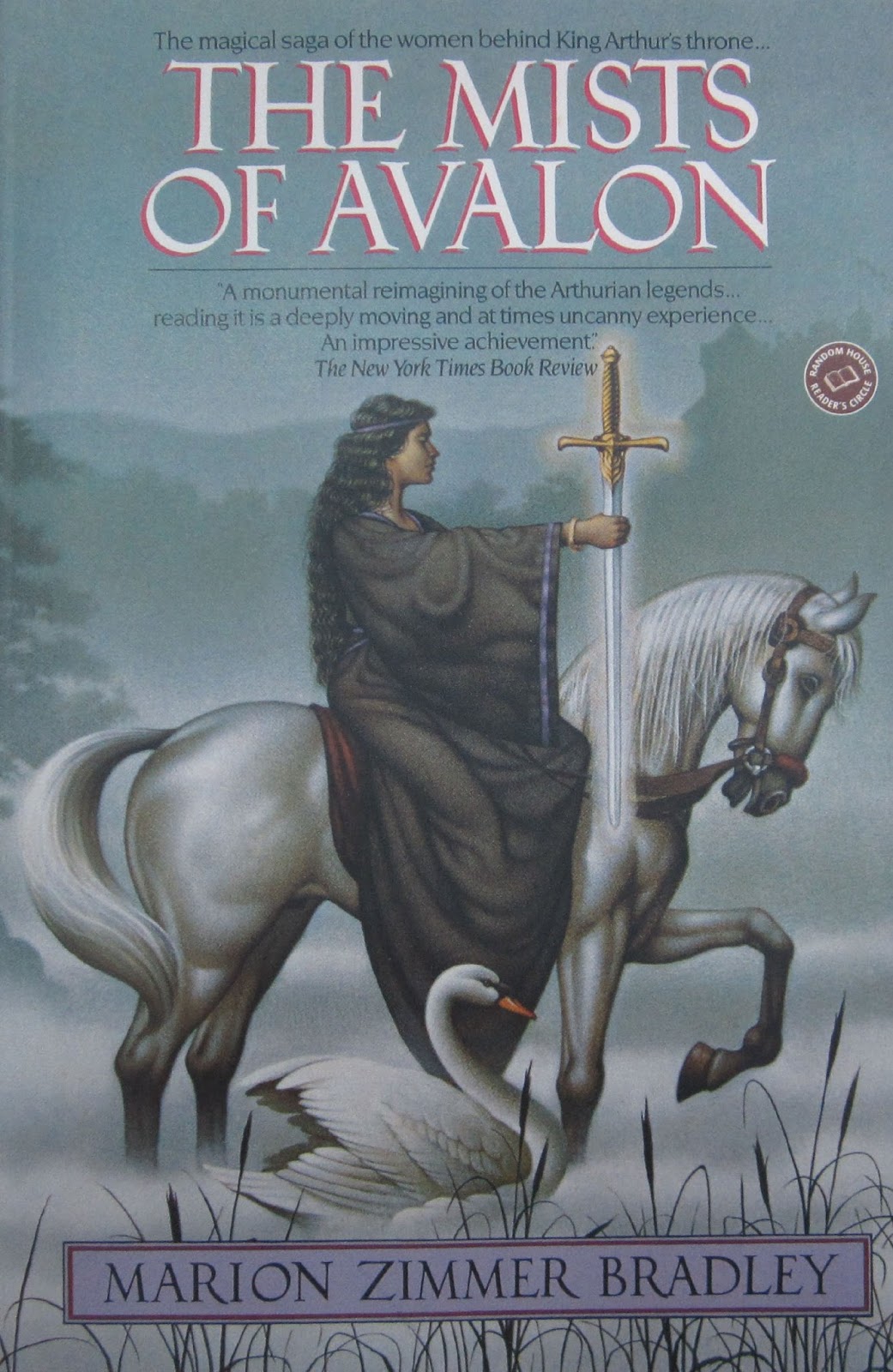
The Mists of Avalon

The Mists of Avalon
By Marion Zimmer Bradley
Knopf, 1982. 876 pages. Fantasy

Marion Zimmer Bradley tells the classic Arthurian tale with a unique twist: it is exclusively told from the perspective of women. It follows Igraine, Arthur's mother; Vivaine, the Lady of the Lake; Gwenhwyfar, Arthur's wife; and Morgaine, his half-sister; and tells the story of the rise and fall of Camelot from their conflicting viewpoints. A masterwork of new-wave feminism, it explores the sexuality of the Arthurian women, from Gwenhwyfar's suppressed longing for the forbidden Lancelot to Morgaine's open celebration of the "life force." It also places the Arthurian legend at the turning point in history when religion was teetering between the ancient druidic customs and the new worship of Christ. The title refers to the fact that the isle of Avalon, where druids and priestesses of the old religion are schooled, is receding further and further from the rest of Britain, hidden behind a literal and metaphorical veil of mists. Arthur is pulled back and forth between ancient Goddess and Christ, and it is the women that surround and influence him that ultimately must make the decision of faith for all of Britain.


As my lengthy summary might demonstrate, this is definitely a book of epic proportions, both in content and in size. It can definitely be slow going at times, too, with long, lagging periods between scenes of action. Despite this, the book is absolutely worth reading. It’s a provocative piece of literature that makes you question the basic norms of morality by turning religion on its head. It throws light on the contradictory powerful/powerless role of women, both in and out of the bedroom. Though written in 1982, its messages are directly applicable to today and make every page a worthwhile investment.

LLK

Wednesday, October 26, 2016

Our Magnificent Bastard Tongue

Our Magnificent Bastard Tongue
by John McWhorter
Gotham Books, 2008. 230. Nonfiction

Most Anglophiles know the traditional history of the English language. Old English came over with the Saxons. The Normans brought a wave of words from Old French and the church added some Latin and voila, Middle English. Then Shakespeare happened, and there’s Modern English. John McWhorter insists that this is only half of the story, and the boring half at that. In Our Magnificent Bastard Tongue he explores the evolution of English grammar rather than vocabulary and does so from an explanatory rather than descriptive standpoint. Where did we get our meaningless “Do” and our “-ing” form for basic present? From the Celts of course. Why did our case system and many other grammatical complexities collapse in the transition to Middle English? Because the Vikings were butchering Old English as their second language. Using nontraditional linguistic evidence, McWhorter tells “the untold history of English.”

Anyone who loves English will enjoy this book and its fast-paced, conversational tone. Rather than the usual high-minded, esoteric tone endemic to academia, McWhorter gives a pop-linguistics telling of the story accessible to any layman. The one fault that I did find with the book was that it is presented some controversial opinions in a pretty one-sided manner. He makes the Celtic influence on English grammar, for example, seem the only logical interpretation of history, when many linguists actually hold contrary views on the matter. Perhaps a voice for the uncannonized and underrepresented needs to be strong to be heard at all, but I still would have appreciated a bit more prevarication. With that one reservation, though, it was a fabulous read and a lot of fun.

LLK

Tuesday, October 11, 2016

Over Your Dead Body


Over Your Dead Body (John Cleaver, #5)
by Dan Wells
Tor, 2016. 303. Horror

John and Brooke are on the run. From who? The law, the Withered... pretty much everyone. Their running isn't aimless, though; they're following the clues lodged in Nobody's memories about the demons that still remain after the massacre at the end of The Devil’s Only Friend. Freed from the framework of the FBI, the two are finally able to do things John's way, stalking and killing Withered using every trick in the sociopathic toolbox. Unfortunately, Brooke is as fragile as ever, flipping between personalities at the drop of a hat and alternately resisting and falling prey to her own suicidal tendencies. As he tries to keep his last remaining friend alive, John must confront the fact that a killer’s life on the road might not be what Brooke needs.

This book is the fifth installment in the series that started with I Am Not a Serial Killer, and this volume is engaging as all the ones that came before it. I have to admit that this is the weakest installment yet, though, as Well’s characterization suffers a bit from over-use. John has already completed his character arc, and seems to have stagnated, mostly just rehashing emotional moments from his past instead of having new ones. The plot twist in this volume also seemed a lot less inventive than the ones in the previous books. That being said, I still love this series, and fans of the other John Wayne Cleaver books will gobble up #5 without question.

LK